Ephemera and Holy Water

Blogger’s Note: If you’ve read this blog over the years, you may have noticed that my activity has declined recently. In April of 2025 I retired from parish ministry. A project unrelated to A Napper’s Companion took up two years and is now fermenting in a drawer as I determine how best to revise it. Meanwhile, I’ve been freelancing for senior citizen publications and am glad to report that my columns have appeared in or are forthcoming in fourteen states–and counting. I’m now preparing a collection of my essays tentatively entitled An Old Soul’s Reader. Cross your fingers for me. I’ll keep you posted. (I’m guessing what follows is a ten-minute read.)

Ephemera and Holy Water

Just after Easter in 2015, wife Kathy and I downsized from roomy to snug—the kind of move some folks make when they spot retirement approaching. Our new, built-in-1926 house was quirky, with a laughably long ramp up to the back door. I can imagine the situation. Mrs. Kaminski wanted to live at home until the end, and her adult children did all they could to make it so. Plenteous handholds in the bathroom. Hooks everywhere. Mrs. K. obviously liked to hang items where they’d be within reach.

Mrs. Kaminski’s ramp

The interior was shabby, though not filthy. Tears here and there in the carpeting throughout, cracking and curling tile—a nightmare of flowers and leaves, olive, ivory and rust—on the enclosed front porch. The walls wore a pallor of dust.

Odds and ends greeted us on move-in day: a jalopy exercise bike in the basement; jars of screws on the late Mister’s workbench; an accordion file of documents re: furnace, roofing, etc.; and holy water in a hall closet. So the Kaminskis were Roman Catholic. I held the yellow spray bottle up to my cheek and played the wiseacre for a photograph. The idea was silly: holy water on hand to spritz mischief as it arose.

The tile

I look into my younger face and acknowledge a regrettable moment. I accepted the pastor’s collar in 2001, so you should expect compassion, insight and maturity from me. Employing tap water that a priest has blessed to shoo away evil warrants a double take and conversation, but ridicule turns the camera away from Mrs. Kaminski and towards Pastor Coleman.

What made me reconsider my victimless teasing was a barn sale in rural Pennsylvania and a musty cigar box of what the guy taking money called ephemera: several prayers copied in disciplined cursive; a Novena to St. Jude Thaddeus; a funeral card from 1973 for Ruth; a hospital discharge instruction sheet for Helen dated 1993; and a pocket My Imitation of Christ by Thomas a Kempis, illustrated “by the noted Armenian Artist, Ariel Agemian, K. S. G. [Knight of the Order of Saint Gregory the Great].” The Rt. Rev. Msgr. Joseph B. Frey signed off on the edition in 1954.

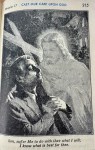
The artwork often shows a businessman of the “Father Knows Best” era carrying a cross or clutching one to his breast. A quotation provides context, something like, “If thou wilt reign with Me, bear the cross with Me.” This caption represents the feel of the work as a whole: “If I be tempted and afflicted with many tribulations I will fear no evil whilst Thy grace is with me.”

This booklet ought not be laughed at or dismissed. Years ago I was afflicted with depression and anxiety and remember well turning to Thomas a Kempis, other religious classics and the Bible to gain a handhold against anguish. Panic attacks are an exquisite form of suffering. It never occurred to me to mist my dread with holy water, but, believe me, if I thought it might have helped, my whole environment would have been as damp as a grocery store produce cooler.

The work of Ariel Agemian, K.S.G.

Folded and tucked within My Imitation of Christ was that page of hospital discharge instructions. Oh, my dear Helen. Judging from the list of medications, she contended with acid reflux, high blood pressure, irregular heartbeat, anxiety, and perhaps bipolar disorder. Turns out I’ve got all but the last of these complaints covered. Helen and I could have started a support group.

Mrs. Kaminski would have fit right in, which brings me back to my clownish sarcasm. I’ll turn 65 in the days ahead. Retirement from parish ministry arrived last year, and I’m increasingly aware of the next big destination on the itinerary. Many Christians insist they’re not afraid of death, but I am—not as terrified as in the past, but the inevitability of this life’s end, in the words of the late atheist Christopher Hitchens, “does concentrate the mind.” Meaning: The great mysteries assemble before thoughtful people, who either take their best guesses or find within themselves negative capability, that quality poet John Keats envied in Shakespeare: dwelling in “uncertainties, Mysteries, doubts, without any irritable reaching after fact and reason.”

A comforting illustration?

Although I’m an ordained Lutheran minister who has wandered out to pasture, I resist every kind of “irritable reaching.” What happens when we die? Anybody who swaggers or blusters when answering this query deserves to be put in timeout. In my own fashion, I stand guilty.

Weighing Helen’s ephemera and recalling my smirk at Mrs. K.’s holy water have sat me down in a corner to think matters over. What likely prompted the former lady of my home to keep blessed Erie water beside her Comet Cleaner? Why did Helen take plenteous medications and copy down prayers and keep Thomas a Kempis nearby? And what do my litany of prescriptions and fervent pleas to God over the years demonstrate? Just this: The three of us are/were scared.

Ours is no small fear. In addition to daily assaults and tribulations, with each passing season we reckon the eventual disposition of our souls—if, indeed, any echo of human beings still sounds beyond this vale of tears. It’s easy to let eternity be frightful. Some of us can’t resist.

Comforting as a fretting Christian might find My Imitation of Christ, Ariel Agemian saw fit to include hellscapes in his illustrations. Even the gospel images are beset behind and before with dark shadows. Mrs. K. and Helen have, as I like to say, gone on to glory. I’ve no business engaging in the hypocrisy of judging what they did to hold themselves together. I join them in clutching my pearls and falling to my knees. My burning incense is the same as placing hope in sacred dew. I take pills much like Helen’s. They deserve better of me.

Now, in my wishful imagination I take their hands and say, “Dear sisters, I was afraid just like you. May our trembling be no more.”

Forgive me, Mrs. Kaminski.

Note: Names and some details have been changed.

My Tortoise, My Teacher

My Tortoise, My Teacher

Now that Mycroft has emerged from an abnormally long hibernation, the Coleman household can exhale and proceed with spring. Wife Kathy and I were worried that he had gone on to glory, but for one detail. His terrarium passed the sniff test. A Russian tortoise, even one the size of a teacup saucer, is going to befoul his surroundings if the repose goes permanent.

Mycroft (always with some mystery debris on his grim face)

A couple of facts about our resident herbivore:

  1. We know that Mycroft is a male thanks to his tail, which is long, thick and curved, compared to the female’s stubby counterpart. Also, the veterinarian said so.
  2. If you see a tortoise and toss it in a pond, don’t. A tortoise, be it Russian, Greek, Moorish or otherwise, is a land reptile. Mycroft enjoys a long winter’s nap, but he would not choose to “sleep with the fishes,” as Luca Brasi did in The Godfather.
  3. I want animals at the Coleman house to be content, and my casual research indicates that Mycroft is fine in his solitude. Opinions are mixed on Russian tortoise sociability. Our low-maintenance pal could experience ennui, but I’m convinced that he is a glad hermit.

And why not? Adopted from a family whose ministrations had wavered, he graduated from lodgings roughly 1’ x 2’ and extreme isolation to 3’ x 4’ accommodations and frequent contact with insufferably cheerful Homo sapiens. Kathy greets him each morning with, “Well, hello, Mycrofty”—a cutie-pie handle for a grim-faced gentleman. She tosses dandelions into his space, waits for him to approach and strokes his head with a fingertip. What could be more agreeable?

Mycroft enjoys a gentle caress on the head.

Our living conversation piece is named after a fictional detective’s brother. In short stories by Arthur Conan Doyle, Mycroft Holmes’ powers of deduction exceed those of his younger brother Sherlock, but “he would rather be considered wrong than take the trouble to prove himself right.” By coincidence, he takes his snuff from a tortoise-shell box at the Diogenes Club, where the most “unclubbable” men in London refrain from conversation. Not only does our armored slowpoke occupy an outsized portion of the dining room, but in warm weather he roams a 6’ x 8’ pen in the backyard. Kathy weeded and seeded the habitat yesterday, which is fair, I suppose. Not only does Mycrofty stand a good chance of surviving his adoptive parents—he can live for fifty years—but he earns his keep in unexpected ways.

View out my hut door–Buddhas embracing Mycroft’s summer digs

For one thing, a pet that hibernates makes winter vacationing a snap. No boarding needed, no guilt, as with a dog, over separation anxiety. Awake or sleeping, bored or engaged, disgruntled or delighted, Mycroft abides. He could stand in for the Chinese farmer in an ancient parable. Ever so briefly:

A farmer’s horse runs away. His neighbors arrive to console him. He responds, “Good, bad, who can say?”

Days later the horse returns with two others. “What great luck!” his neighbors say. His answer: “Good, bad, who can say?”

While trying to tame one of the horses, the farmer’s son is bucked and breaks his leg. “Oh, how sad,” the neighbors say. The farmer’s reaction remains the same.

Soon thereafter the nation’s army comes to round up troops to serve in battle. The son is incapacitated and spared the danger of war. Of course, the farmer is steadfast.

The moral is obvious. Anyway, the only reminder I need of The Parable of the Chinese Farmer is a glance at Mycroft’s countenance. “Don’t get yourself in a lather, John,” he may as well say. Message received.

The most counterintuitive guidance our quiet comrade has given me regards partying. In short, many social gatherings and celebrations leave this recent retiree crotchety. Not sure why. Maybe it’s that the ground of even innocent encounters is currently strewn with eggshells. Alas, adulthood often comes with a simple obligation: Like it or not, show up. In such cases, I imitate Mycroft, and all is well with my soul.

Amidst those gathered, I find an open seat. As my girth sinks into the armchair or couch, the reptile within me hunkers in safety. If somebody brings me a drink, I nod slightly and mouth “thank you.” If a bouquet of dandelions or some other salad arrives, I won’t say no. If the host happens by and passes a finger over my forehead, I feign pleasure. Most important, when controversial topics arise, I become a Russian tortoise. Lacking a shell, I raise my shoulders up around my ears, slouch in place and keep vigil. Everybody can see the whites of my eyes.

Mycroft has taught me well. I relax and mind my manners. I love this life of mine, but I’ve yet to figure out how to achieve our tortoise’s tour de force. Ah, to nap for five or six months each year.

Mycroft and Obi-Wan catching up after hibernation.

A New Post on Matters of Conscience

A New Post on Matters of Conscience

Dear Blogging Followers and Friends,

I’ve posted an essay entitled “Watch Your Language: Words Matter Under Authoritarian Rule” on my Matters of Conscience blog. As you may remember, I created this blog some years ago to share thoughts that I felt would be irresponsible to withhold. The past ten years have been wounding for our country. In my opinion, citizens should do whatever they can to preserve, protect and defend the Constitution of the United States of America. My platform is minuscule, but I place it at the nation’s service.

As you also know, I have this blog, A Napper’s Companion, for pieces that don’t typically raise readers’ blood pressure. Even so, I simply announce here material on Matters of Conscience that is valuable. It’s a bit long but I hope worthwhile.

Please be well, friends,

John Coleman

Notes from Retirement: On Grief and Closure

Notes from Retirement: On Grief and Closure

The hut

“I miss Bill.” As Kathy and I awoke to another day, I told her so. “I really loved that guy.”

“I know you did,” she said.

Announcements come from me unbidden, dregs from a retired pastor’s heart. Parish ministry has been rich with lovable souls. Bill happened to be on my mind lately. He died three years ago, one organ tanking after another. 81.

Just now I looked up his obituary, enjoyed his grin and recalled details. Small business owner, enviable domestic travels with wife Judie, who survives. Nowhere does it say that Bill was a mischievous character, but those words cover as much territory as Bill’s Fine Foods and St. John’s Lutheran Church.

Bill: Is this not a mischievous grin?

If a bear were within reach, Bill would poke it. A fellow parishioner, Rusty, relished remembering a dinner at St. John’s during which Bill held forth with embarrassing abandon. He never mentioned about what exactly, only that Judie was working her jaw and pursing her lips.

By coincidence, Rusty followed Bill and Judie on the drive home. Through the darkness, he could see a silhouette of the long-married couple, wife leaning toward husband and wagging her finger at his face, husband absorbing a first-string, All-American scolding. The account took a while, as the stout Rusty growled with laughter every sentence or two.

Bill and Rusty sat together for decades of Church Council meetings and were more brothers than brothers. The latter beat the former to the grave by a few years. As Bill neared his end, we sipped lemonade at his dining room table. Lower and lower he sank into his wheelchair, gravity itself having its way with his spent body.

He said something commonplace: “I miss Rusty.” His simple resignation and vulnerability move me still. That mischievous character’s eyes may as well have whispered, “It won’t be long now, Pastor.”

“I miss Bill.” “I miss Rusty.” Words better wept than spoken.

Fresh out of seminary; fresh collar

Since hanging up my Roman collar in April of 2025, I’ve settled into the silence of my backyard hut and let my ideas roam. Thanks to a dark turn of mind, I’ve thought a lot about grief: mine, Bill’s, people I love whose loss is devastating. I’ve reckoned anew the truth that mourning is a law unto itself. You can’t escape it. For a “little day”* you might be in the clear, but eventually the bone-sadness will administer its punishment. If you’ve kept bedside vigil, kissed a forehead, begged for a reprieve, watched a chest cease its rising and falling, you know. Tears are only the beginning. Nausea, fog, chest pain, you name it. Hearts do break. You can feel it.

Closure supposedly awaits those who work for it, but I wonder. In a 2011 CNN interview with Anderson Cooper, the late Christopher Hitchens said this of his mother’s passing: “There’s no such thing [as closure] and it wouldn’t be worth having if it were available because all it would mean is that some quite important part of you had gone numb. ‘Oh, how nice, I don’t feel anything about her anymore.’ No!”

If Hitchens was right, then it’s also daft when news reporters hope a disaster victim’s survivors can start finding closure before the funeral begins. This is boilerplate vocabulary used to put sad stories to bed and tuck them in tight. Think thoughts and prayers.

Again, no. When mindful folks say closure, they mean the ability to carry on, at last finding that joy in those of blessed memory keeps pace with the suffocation of their absence. The image of turning a page or closing a door is wrong. Heaven forbid the typeface ever lacks Mom or Bill or the lock clicks shut.

Breathing is closer to the truth. Parishioners in raw grief have told me they forget to breathe. They rest a hand on their chest, signaling that the involuntary act of taking air in and letting it out requires startling effort. Maybe mourning should be understood breath by breath. Maybe progress means that your lungs can fill with ease.

I hadn’t figured on my pension including such reminders of what I already knew well. I had Kahlil Gibran’s wisdom memorized, but it now returns to my hut’s sanctuary, more dregs from a pastor’s heart: “Together [joy and sorrow] come, and when one sits alone with you at your board, remember that the other is asleep upon your bed.”

And missing Bill, why here, why now? He mostly visits as a cardinal at my feeders. A friend once claimed that a cardinal’s arrival announces God’s presence. I don’t believe this, but imagine that if Bill had permission, he would send a bird to say, “All is well, Pastor. I miss you, too.”

I breathe in and out, grateful that neither Bill nor I want closure. Carrying on will do.

A few weeks after Bill’s passing, a cardinal arrived at the feeders

*From the hymn “Abide with Me”: “Swift to its close ebbs out life’s little day; / Earth’s joys grow dim, its glories pass away; / Change and decay in all around I see; / O thou who changest not, abide with me.”

And P. S. “Rusty” is a made-up name.

Announcing a Post on Matters of Conscience

Dear Friends and Blog Followers:

For more than a decade I’ve kept most controversial essays away from A Napper’s Companion. Nobody visits this site to learn my thoughts on politics and societal upheaval. But now we have a problem. We’re in the all-hands-on-deck phase of what I take to be our American crisis. In addition to information included in the full post available on my Matters of Conscience blog, consider what MAGA pillar Steve Bannon has to say about the 2026 midterm election: “We’re going to have ICE surround the polls come November. We’re not going to sit here and allow you to steal the country again.” (That Bannon lacks official White House credentials doesn’t seem to matter.)

So, are you prepared to arrive at your polling places in November surrounded by pissed off masked men with weapons drawn? If you depend on nothing other than Fox News and Facebook for your information, you might think I’m being an overly dramatic libtard here. First, I’m neither a Democrat nor what you could consider a run-of-the-mill liberal. Second, when MAGA folks employ their favorite slur, they’re often unwittingly punching above their weight.

The blog post I’m letting you know about (link provided above) is still fairly fresh, and yet yesterday two public figures of note have weighed in on my side.

Paul Krugman, a Nobel Prize laureate in economics, issued this warning: “So it’s just being realistic to say that MAGA will try, somehow, to prevent voters from having their say. Will ICE try to prevent blue districts from voting? If that fails, will they reject the results, in a midterm version of Jan. 6? Call me alarmist, but remember: The alarmists have been right, and the people telling us to calm down have been wrong, every step of the way.”

And Fresh Air Terry Gross shared this heads-up from Atlantic Writer Robert Kagan: “I think we’re already well into a dictatorship. It’s just a question of whether [Trump] will go ahead and basically disrupt the ’26 elections, which I think he’s made it clear he has every intention of doing now. So I think that this should be a five-alarm fire for everybody.”

My prediction: Donald Trump will invoke the 1807 Insurrection Act to postpone or cancel the elections scheduled for November 3, 2026. He’ll accept no court decision prohibiting this action, nor will any mechanism short of the Republicans ushering their President and his administration out the White House door avert chaos. I know of no convincing, coordinated preventive response being planned or even contemplated at present. We shouldn’t kid ourselves, especially the elected officials with the power to act, if only they would summon the necessary courage and selflessness. Time grows short.

Thoughtful citizens may find themselves faced with choices I briefly suggest at the end of my blog post, “Plain Notes to Self Under Authoritarianism.” May this not be so.

Love,

John